
Foreward
Sources listed below, but let's be real, the study of mythology is rarely about any single ‘truth’. That is the fun of picking apart legends of old. Finding out what is agreed upon, what is not, and what is twisted beyond recognition overtime.
I am not a professional historian. Real research would involve reading a lot of books and going to libraries or archives, and this is not that. Wikipedia and the Encyclopedia Britannica were my most helpful sources outside what amounts to mostly random websites. I’m simply summarizing what I feel stands out as most relevant to Elden Ring from those sources.
I claim no overarching theory or grand thesis. My only hope is to explore some of the foundational gods from the foundational civilization and see how they may serve as inspiration for Elden Ring. We know Miyazaki, GRRM, and the talented staff at FromSoft are big on partial inspiration but usually with some clever twists and crossovers. I do think the gods from ancient Mesopotamia are one of these inspirations. As you’ll quickly see, these gods inspire future pantheons, so I bet there’s a good chance they have partially inspired Elden Ring’s too. If people like this post, I have a few more in the chamber I think are also relevant.
Titles
"The Queen of Heaven”; “Red Queen of Heaven”; “Mistress of Heaven”
“Lady of the Date Clusters”
“The Martial One”; "Destroyer of Kur"; “Victory”
“Ishtar of the Stars”
Domains
Ishtar is a goddess of great power and import, whose cult lasts basically the entire history of Mesopotamia and can be traced to the start of Christianity itself. Over these many eras she picked up an expansive set of domains.
Champion of women & the non-binary
One of the most important female deities of the Mesopotamian pantheon, Ishtar was bestowed the highest rank in the pantheon by the Assyrians, even above their own god Ashur. Votive objects from the temples of that period were noted by experts as being evidence that she was popular among women and individuals who went against the gender binary. In one hymn, she is even given the ability to transform men into women. Some claim Ishtar herself was dimorphic, as she appears as both genders in different myths & prayers. For once we have an ancient figure on the right side of history. 🌈
Worship of Ishtar was often accomplished by baking cakes with ashes. Some of these cake molds were found shaped like curvaceous women in provocative poses. Some scholars suggest that these icons were representations of Ishtar herself. Turns out erotic cakes are a tale as old as time!
Goddess of love (but not motherhood)
Although Ishtar was purported to always have many domains, her first associations as the goddess Ianna seem more closely associated with love than war. She is characterized as impulsive and youthful and explicitly not as a good mother. According to one scholar, "Ištar was not temperamentally disposed" towards motherhood or domesticity. To the extent she was a god of life, it was more of abundance and plenty.
Ishtar’s cults often centered around the town brothel. I assume this not only helped with her popularity, but also her cult’s ability to quickly and widely network. This could contribute to her expanding powers and domains both in real life and myth.
A final but extra fun fact, apparently Ishtar is a BDSM figure of some import. In one myth, her portrayal is cited as one of the first examples of the dominatrix archetype. In this myth, those she gets to submit can ask for mercy and she will stop. The fet community considers this one of the very first nods to safewords.
The original warrior princess

Equally important is Ishtar’s domain over war and conquest. This cannot be underrated. Heroism & sexual prowess were connected back in the day, giving her power over both. There is a reason she was invoked by kings.
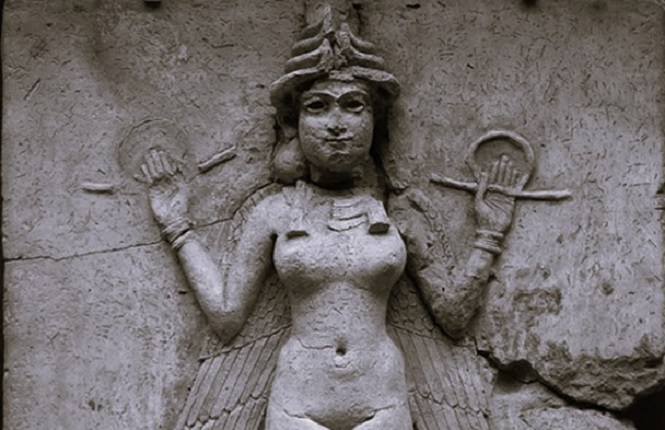
In myth, she was often shown winged, bearing arms, and accompanied by lions. “Clothed in terrifying radiance”, her prowess in battle meant fighting was sometimes referred to as the “dance of Inanna”. In myth Isthar can control thunderstorms, floods, and rains, which she uses to wage war in the real and divine worlds. She used these powers to conquer temples of man and topple an entire mountain. The latter she found offensive merely for existing and is believed to represent the conquest of the Akkadian empire.

The morning & evening star
Ishtar’s final critical domain is that of the heavens. I imagine it’s hard for us modern folk to truly understand what the ancient’s relationship to the stars was, but it was clearly much more important than ours.
She is specifically associated with Venus, both as the morning & evening star. The Sumerians were smart enough to figure out that this was the same star, even though it moves erratically. This erratic movement often underlies Isthar’s myth and is why one of her symbols ends up being the 8-pointed star.

Mythically, her association with the heavens is mirrored in her relationship with her twin brother, the sun god, Utu/Samash. She is extremely close to her brother, calling on him for counsel in many myths. Some scholars think they might have even been a little too close.
A goddess of many multitudes
Ishtar had even more domains than those listed above. Justice is a big one. Other examples include her association with storehouses, dates, wool, meat, & grain. She even holds sway over seemingly contradictory domains. Examples here include her sway over “fire and fire-quenching, rejoicing and tears, fair play and enmity”.
Some theorize she gained these domains via conquest. Others think she gained them via the gradual spread of her cult of brothels and its willingness to absorb local customs. Whatever the case, her capacity for a great number of powers was even recognized in her time. It features in some of the earliest myths of hers, where she agitates against the other gods for more powers.
With her many domains comes many titles & alternate names. The only other god with a comparable number seems to be the trickster god, Nergal. Some claim that when you account for these extra titles and names, Ishtar appears in more myths than any other Mesopotamian deity.
Relevant Myths
Ambitious from the beginning
Ishtar is often portrayed as young and impetuous, constantly striving for more power than she had been allotted.
Her aggressive and impatient attitude is apparent in many myths. For instance, immediately after the establishment of cosmic order by Enki, she complains that the other gods have special domains & powers but not her. She is waved off, yet she persists. This leads to her wresting control over the divine laws of her time.
She steals the Elden Ring of her time
The objects of theft are called the ‘Mes’. They are described as divine decrees that are fundamental to the metaphysical and ethical laws of the times. They are also noted as physical in nature – something you can possess. Individual Mes may represent objects like specific instruments while other Mes represent abstract principles, like victory or deception. If I had to guess, they may have inspired great runes themselves.
The background on these Mes is that they are created by the god that would eventually become Marduk but handed over to Enki, the god of wisdom & creator of humanity, for safekeeping.
A series of myths is used to establish the Mes. During these Ishtar is a common character, often complaining about her lack of influence and power compared to other gods. Eventually she convinces Enki to hand the Mes over to her while he is drunk. Ishtar returns to her home with these sacred objects now in her control. Some think this story symbolizes her transition to the most powerful god in the pantheon & the queen of heaven.
She marries a shepherd, sends him away, then avenges his death

In one of the more well-known myths, Ishtar choses a young shepherd named Dumuzi (or Tammuz) to marry. She is also courted by a farmer, but her brother Utu counsels she pick the shepherd as he can provide a nicer life. After initially considering the farmer, she chooses the shepherd. They consecrate this marriage with some sort of sacred ritual.
Ishtar is not considered particularly faithful, which likely drives a bit of resentment on her husband’s side. This probably informs his devil-may-care attitude when Ishtar ends up trapped in the underworld due to her sister’s schemes. Ishtar is not one to be trifled with, so she ends up forcing her husband to take her place when she finds out he is not mourning her properly. This ends up deifying Dumuzi more directly, making him responsible for the changing of the seasons and turning him into an undying god of sorts.
Despite his place in the pantheon, Dumuzi meets his demise in another myth. In this tale, Ishtar discovers her own son is responsible. She finds him and the other culprit and transforms them into “the waterskin that men carry in the desert” in her rage. She uses this sacred object to pour a funerary libation for her late husband.
Her dangerous descent to the underworld
Described already in the previous section, we’ll briefly reframe this myth for Ishtar. Ever the power-hungry goddess, she ventures to the underworld to as part of her conquests. Her sister, the Queen of Death, agrees to let her enter, but tricks her into abandoning her magic items. Ishtar then ends up trapped and condemned to death!
In her time of greatest need, Ishtar’s top minister pleads with the other gods for help. They send agents to rescue her. She almost escapes but is caught. After all this commotion she is offered a deal. If she can find a replacement, she may leave. She discovers that in her absence, her husband has not mourned her, and so sends him in her stead.
She seeks power from trees
There are also a handful of myths connecting Ishtar to trees. She even has a strong connection to a local tree called the desert poplar that will look familiar to us all.
In one of the most relevant myths, a young Ishtar sets out into the world and finds a “huluppu tree” growing on the bank of the Euphrates. She moves the tree to her temple and tends it, hoping to carve it into a throne eventually. It grows large, but soon attracts a monstrous serpent, bird, and demon who begin to live in it.
Gilgamesh comes and slays the serpent, causing the other two creatures to flee. Him and his boys carve it into a bed and throne and give it to Ishtar as a gift.

In another story, she has her brother, the sun god Utu, take her to the tree of knowledge in the underworld. She eats its fruit and becomes knowledgeable in the ways of pleasure. Some of this story may have informed the eventual parable of Adam & Eve.
Syncretism
Mesopotamian Region – Ianna, Astarte
Ianna is the first instantiation of Ishtar as she was known by the Sumerians. Ianna & Ishtar apparently start out as separate gods, but become merged sometime during the reign of Sargon of Akkad. From then on she becomes known as Ishtar to the Akkadian Empire, Babylonians, and Assyrians. My initial findings indicate that this change allowed the kings of the time to shift her focus away from love and towards war.
Later on she became Astarte to the Phonecians, and in doing so her focus shifted even more toward war and hunting in particular. Her association with lions becomes even more pronounced and she is often seen carrying lunar & solar items. Astarte’s most interesting link? According to Wikipedia, her “iconographic portrayal” is “very similar to that of Tanit”.

Greek/Roman – Aphrodite/Venus
Ishtar & Astarte eventually turned into Aphrodite. The cults of the Greek god of love in Sparta & Cythera both feature statues of the goddess in arms, a nod to her previous warlike forms. And from Aphrodite we get Venus, the planet Ishtar was always associated with.
What I also like is Venus being the goddess of ‘victory’. Much like emperors of Mesopotamia, Julius Caesar claimed her for legitimacy. In this case, he claimed Venus as his ancestor instead of concubine.
Christianity – A pagan “Queen of Heaven”
Ishtar is not mentioned by any of her names in the Bible, but she is referenced as "the Queen of Heaven" in Jeremiah 7:18 and Jeremiah 44:15–19. These sections warn the reader not to worship her, including specific mention of funerary libations.
In addition to this reference from the Bible itself, I read one scholar who claims that early Christians assimilated elements of Ishtar into the cult of the Virgin Mary. This seems possible considering her cult seemed active up through the earliest era of Christianity. I also wonder if there is any connection to Mary Magdalene and “the whore of Babylon”.
Speculation
This is an inspiration for Marika
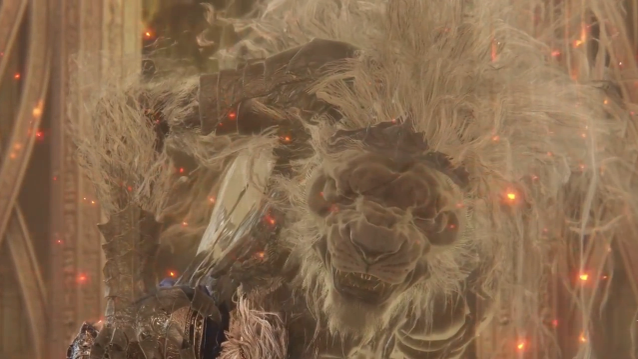
There is a ton of thematic resonance here. We’ve got golden trees, guiding stars, lions, warmongering, dimorphism, and much more.
My favorite implication by far is that Ishtar is theorized to have been downplayed in history due to her position as a powerful woman who did not fit cleanly into a mother or daughter archetype the patriarchy sells to women. This mirrors Marika’s position as the most powerful person in Elden Ring who has been working to downplay the importance of previous gods, religions, and social structures.
Source Links
- https://www.britannica.com/topic/Ishtar-Mesopotamian-goddess
- https://en.wikipedia.org/wiki/Inanna
- https://www.brooklynmuseum.org/objects/166067
- https://www.worldhistory.org/Inanna/
- https://public.archive.wsu.edu/hughesc/public_html/gilgamesh_Ishtar.html
- https://tracymarrs.com/2021/11/21/the-descent-of-inanna-part-1/
- https://en.wikipedia.org/wiki/Venus_(mythology)
- https://en.wikipedia.org/wiki/Aphrodite